A Spider New to Virginia collected on HSC Campus

Travis Clark ’11, collected a specimen of Crossopriza lyoni while working as a lifeguard at the college swimming pool. Native to southeast Asia, this rare species has been found previously in North America only in Texas, Florida and Kansas. Not only is this a new record for Virginia, but for all of North America east of the Mississippi River!

Osric Forrest ’12 Presents Summer Research at MARCUS Meeting

On October 9, junior biology major Osric Forrest attended the 12th annual Mid-Atlantic Regional Conference of Undergraduate Scholarship.  There he delivered a poster presentation of the summer research he conducted under the guidance of Dr. Kristian Hargadon.  Osric’s work involved the characterization of two immature dendritic cell lines and their responsiveness to maturation/activation stimuli.  Using real time RT-PCR and ELISA techniques, Osric demonstrated that both the JAWSII and DC2.4 cell lines are effective in vitro models for studying dendritic cell maturation.  These cells are therefore very useful tools for studying a variety of aspect of dendritic cell biology.  Dr. Hargadon’s current research will utilize these dendritic cell lines to evaluate the influence of tumor cells on dendritic cell maturation and activation, processes that are critical for generating effective immune responses.  Our preliminary data demonstrates that tumor cells can suppress dendritic cell activation, and we are currently evaluating the extent of tumor-induced immunosuppression and the mechanism by which it occurs.  This information will offer insights into the basis for tumor-induced immunosuppression and may identify novel targets for anti-cancer immunotherapy.  Osric and other Hampden-Sydney students are actively pursuing this line of research with Dr. Hargadon.  Osric will be presenting another poster of his research in November at the VA Branch meeting of the American Society for Microbiology at Lynchburg College, and Dr. Hargadon will be delivering an oral presentation at this meeting as well!

Osric presenting his poster at the MARCUS meeting

Osric presenting his poster at the MARCUS meeting

Microbiology Students Learn Techniques to Identify Bacteria

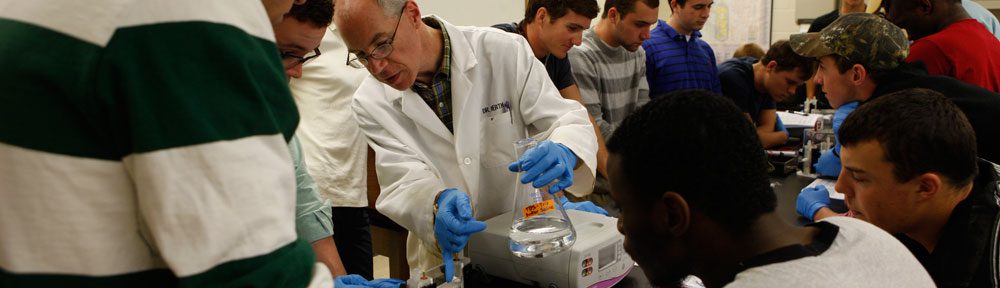
This semester 9 students taking Microbiology with Dr. Kristian Hargadon have been learning diagnostic techniques for the identification of bacterial species.  As part of a semester-long project, these students have recently been giving an unknown bacterium and are now applying the techniques they are learning in the laboratory to identify their organism at the species level.  Techniques to be used include differential staining techniques to visualize their microorganism as well as biochemical testing to determine metabolic and enzymatic properties of their bacterium.  Upon identifying their unknown organism, students will prepare a written report that describes their laboratory research as well as the significance of their bacterium.

Micro students learn techniques to identify bacteria

Now don't they look like they're having fun???

Plant genetics project, Part II: Infesting the soil

The H-SC Genetics class’ work with Virginia Tech researchers continued this with a visit from Professor Dorothea Tholl and her undergraduate student Brendan Karlstrand.

Dr. Tholl introduces her research work to the class

Dr. Tholl introduces her research work to the class

The students were introduced to the fungus gnat (Bradysia) and how its larvae feed on the roots of the Arabisopsis thaliana plants they starting growing 2 weeks ago.  Different lines of A. thaliana were planted with mutations in genes that affect the plant’s ability to defend itself against being eaten by these larvae, and the goal of the project is to understand the effect these mutations will have on plant chemical defense mechanisms.

Dr. Tholl shows the students how to prepare the plants for infestation

Dr. Tholl shows the students how to prepare the plants for infestation

Thinning out the plants

Thinning out the plants

Cutting the bridal veil-----in this case, it'll be used for insect netting

Cutting the bridal veil-----in this case, it'll be used for insect netting

The students carefully infested half of their plants with the fungus gnat larvae provided and left the other half uninfested for comparison.  The results after 2 weeks exposure will be used for both the H-SC Genetics class and for Dr. Tholl’s research program at Virginia Tech.

Virginia Tech student Brendan Karlstrand demonstrates to the class how to isolate and infest the plants with fungus gnat larvae

Virginia Tech student Brendan Karlstrand demonstrates to the class how to isolate and infest the plants with fungus gnat larvae

Jonathan Park ’12 receives Travel Award for presentation of his summer research

One of our summer research students, Jonathan Park ’12, has received a Travel Award from the Council on Undergraduate Research (CUR) to partially defer the expenses to travel to the annual meeting of the American Society for Cell Biology (ASCB) in Philadelphia in December.  Jonathan was among a group of students selected from across the nation for this award.  His research was conducted with Professor Mike Wolyniak over the summer and made some intriguing observations on the role played by a pair of proteins found in the membrane of the cell nucleus in the regulation of how cells control their division.  Congratulations to Jonathan for his hard work in attaining this honor!

Giant millipedes!

On a field trip to the Featherfin Wildlife Management Area last week, the Biology of Arthropods class collected a wide diversity of arachnid and myriapod species, but the most striking were two specimens, a male and a female, of the giant millipede Narceus americanus. This species ranges from southern Canada to Florida, and recent work on its DNA has shown that there are actually a half-dozen genetically isolated populations involved, whose distribution has waxed and waned over the past million years with the comings and goings of continental glaciers.

Narceus americanus, about as thick as a pencil and 5 inches long, is the largest North American millipede.

Narceus americanus, about as thick as a pencil and 5 inches long, is the largest North American millipede.

As shown by the picture below, N. americanus is often attacked by the glow-worm Phengodes. The glow-worm runs the millipede down, flips it over and with a bite severs the ventral nerve cord to disable the potent chemical defenses of the millipede.  The paralyzed millipede is then reduced to soup by regurgitated enzymes and sucked up by the glow-worm.

The glow-worm Phenogodes is a specialist on Narceus.  See text above for details.
The glow-worm Phenogodes is a specialist on Narceus. See text above for details.