Meeting of Southeastern Partners in Amphibian & Reptile Conservation

Dr. Goodman’s Herpetology class (BIOL 385) took a 4-day trip to the annual meeting of Southeastern Partners in Amphibian & Reptile Conservation in February 2013.  We stayed in the lodge at Hickory Knob State Park in South Carolina and enjoyed a limited amount of “herping” due to cold weather during the stay (students below show our limited findings).  The meeting was full of informative talks, workshops, and posters presenting research and applications of concepts covered in class.  The HSC students, in their sophomore and junior years, engaged in lively conversation throughout the weekend with graduate students, post-docs and faculty, and also working professionals in a variety of government and non-profit roles.

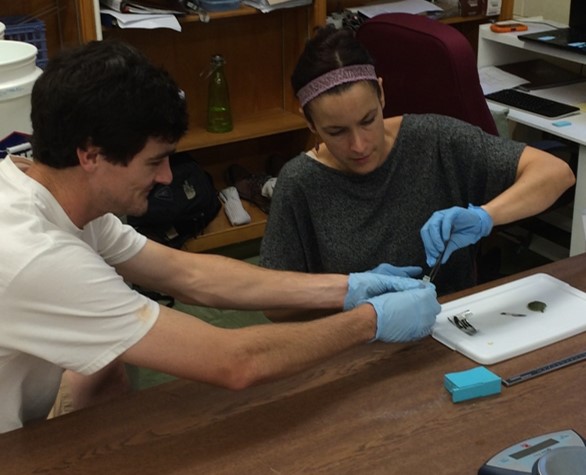
Students with cold, sleepy Green Anole (Anolis carolinensis)

Cricket Frog (Acris crepitans)


Road trip!

H-SC senior biology major presents research at Harvard Medical School

Yonathan Ararso ’13 recently gave a poster presentation of his summer research project at The New England Science Symposium held in the Joseph B. Martin Conference Center of the Harvard Medical School. The work, titled “Disarming Cancer’s Signaling Corridor: How Deletion of Endothelial Cell Notch Ligand Jagged 1 Suppresses Tumorigenesis,” discusses the role of endothelial cell initiated Notch signaling in the context of tumorgenesis. The Howard Hughes Medical Institute funded project was undertaken during the summer of 2012 at Weill Cornell Medical College in New York City and dealt with investigating how inhibition of endothelial cell Notch ligand Jagged 1 affects tumor growth and metastasis in breast cancer.
Established in 2002, The New England Science Symposium provides a forum for postdoctoral fellows; medical, dental and graduate students; post-baccalaureates; college and community college students to share their biomedical and health-related research activities through oral or poster presentations. (www.mfdp.med.harvard.edu/med_grad/ness/)

Yonathan with his poster

Ecology field trip to the Eastern Virginia Birding & Wildlife Festival

Dr. Goodman and students in her Ecology class (BIOL 203) took a 3-day field trip to the Eastern Virginia Birding & Wildlife Festival in October of 2012.  They stayed in a rustic bunkhouse in Kipotpeke State Park and enjoyed campfire dinner, including first ever smores for a couple students!

Highlights of the trip included a keynote lecture by David Allen Sibley, famous for his illustrated bird guides, a visit to the Virginia Aquarium & Marine Science Center, and a workshop / field trip to learn about and identify various species of dragonflies.


 We also took a field trip to the Savage Neck Dunes Natural Area Preserve (image below at trailhead), which is one of the few intact Chesapeake Bay coastal dune ecosystems that remain in Virginia.  Rare plants and animals there include the federally listed Northeastern Beach Tiger Beetle (sign below).


Ecology trip to York River State Park

Dr. Rachel Goodman and several students in her Ecology class (BIOL 203) spent an afternoon at York River State Park in the fall of 2012.  We took a guided canoe tour of Taskinas Creek and learned about tidal wetlands and the important roles they play in dampening storm surges and serving as nurseries for many species in the Chesapeake Bay.  We spotted some of the unique animals that inhabit this community, including a few species of crabs (Daniel Adams holding one below) and several bird species.  We also took out seines and dip nets to catch a few fish (Hakeem Mohammed and Jason Haas seining below).

Dr. Shear wins major NSF grant

Dr. William Shear of the Hampden-Sydney Biology Department learned yesterday that his research group’s proposal to the National Science Foundation of the United States has been funded in the amount of $585,000. The proposal involves team members at Auburn University, the Field Museum of Natural History (Chicago), VMI, VPI, and international collaborators from Denmark, South Africa, Mexico and other countries around the world. The goal of the three-year project is to construct a phylogenetic tree for the Class Diplopoda (millipedes) a globally important and megadiverse group of arthropods. The tree will be based not only on morphology, but also on comparisons of the transcriptomes (total transcribed RNA) of more than 100 species. Dr. Shear will participate in collecting and identifying the species to be used, which will involve travel to various localities in North America, Costa Rica, Thailand and South Africa. In addition he will study the chemical defenses of millipedes in collaboration with Dr. Tappey Jones of the VMI Chemistry Department.

Dr. Shear is the author of over 200 scientific papers and book chapters, and as a taxonomist has named and described more than 300 previously unknown species. He is also known for his paleontological work on Devonian terrestrial ecosystems.

Dr. Kristian Hargadon and Dr. David Baltimore to Co-Keynote at Harker Research Symposium

Elliott Assistant Professor of Biology Dr. Kristian M. Hargadon will be one of two keynote speakers at the Harker Research Symposium at The Harker School in San Jose, CA in April.  Delivering the other keynote address will be Dr. David Baltimore, who received the 1975 Nobel Prize for Physiology or Medicine for his discovery of reverse transcriptase and the role of RNA viruses in tumor cell transformation.  Dr. Hargadon was invited to speak about his cancer research at Hampden-Sydney as well as about his story as a scholar-athlete and the role played by both academics and athletics in his life.  His address is entitled “From Gym Rat to Tumor Immunologist:  A Scholar Athlete’s Path to Cancer Research.”  Additional information can be found at the following link:  http://www.harker.org/page.cfm?p=2683

Dr. Kristian M. Hargadon to serve as special Guest Associate Editor for Frontiers in Tumor Immunity

Eliott Assistant Professor of Biology Dr. Kristian M. Hargadon ’01 was recently invited and selected to serve as Guest Associate Editor and to host a Research Topic on Tumor Cell/Dendritic Cell Interactions and the Influence of Tumors on Dendritic Cell-mediated Anti-Tumor Immune Responses and Dendritic Cell-Based Tumor Immunotherapies for the scientific journal Frontiers in Tumor Immunity.  As Associate Editor, Dr. Hargadon will work with leading investigators across the globe and recruit contributions of a series of manuscripts to be published in a special issue of the journal dedicated to tumor/dendritic cell interactions, Dr. Hargadon’s own area of research expertise.  This is an excellent opportunity for fostering collaborations in this field and bringing focus to this important area of cancer research.

Molecular Biology class takes electron micrographs of discovered bacteriophages

Zac Cranston ’14 and “CremePhraiche”, a bacteriophage he discovered on the H-SC campus

The Molecular Biology class took a field trip to the University of Mary Washington to use their electron microscopy facility as part of the class’ ongoing participation in the Howard Hughes Medical Institute (HHMI) Science Education Alliance.  This marks the second year of H-SC’s participation in a nationwide study focused on the collection and characterization of new bacteriophages, or viruses that infect bacteria, from the environment.  UMW Drs. Lynn Lewis and Kathy Loesser-Casey kindly gave the class their time and expertise in helping them to take electron micrographs of their bacteriophages which they will use to better understand the properties of each strain.  Representative DNA samples from the class’ collection have been sent to the University of Pittsburgh for sequencing, and analysis of the sequence will take place at H-SC over the spring semester.

Dr. Shear coauthors “most cited article”

Elsevier Publishing, one of the largest international publishers of scientific journals, has informed Dr. Bill Shear that his article (coauthored with Dr. Greg Edgecombe of the British Museum of Natural History) is one of the top five most-cited articles in the journal Arthropod Structure and Development for 2009-2011.

Recognition as “most-cited” means that other articles published subsequently have referenced Shear & Edgecombe’s article more often than any others.

The article, “The geological record and phylogeny of the Myriapoda,” brings together current and past information on fossils and molecular relationships of this important mega-diverse class of animals, which includes millipedes and centipedes.  Dr. Shear is recognized as a leading authority on millipedes, and Dr. Edgecombe on centipedes.

Full citation:  Shear, W. A., & Edgecombe, G. D.  2009.  The geological record and phylogeny of the Myriapoda.  Arthropod Structure and Development 39(2-3):174-190.


Dr. Shear studies “world’s leggiest animal”

Collaborating with two colleagues, Dr. Paul Marek of the University of Arizona and Dr. Jason Bond of Auburn University, Dr. Shear has published a paper on the biology of Illacme plenipes, a millipede that has the most legs of any known animal–over 770! The species is known only from a very small area in California. The paper includes anatomical details studied with electron microscopy, DNA barcoding, behavior, and environmental simulation, all modern techniques in today’s systematic biology.

Here are some websites with news stories about the work:

http://news.discovery.com/animals/leggy-millipede-121114.html

> http://www.newscientist.com/article/mg19025555.600-worlds-leggiest-animal-redi
> scovered.html

(http://www.livescience.com/24765-750-leg-millipede-leggiest-animal.html)
> Casey (http://news.discovery.com/animals/leggy-millipede-121114.html).
>