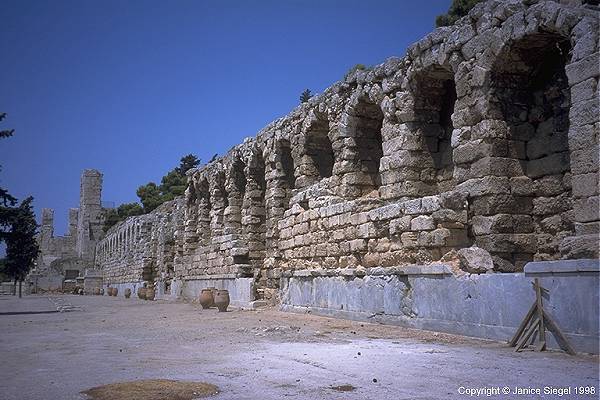
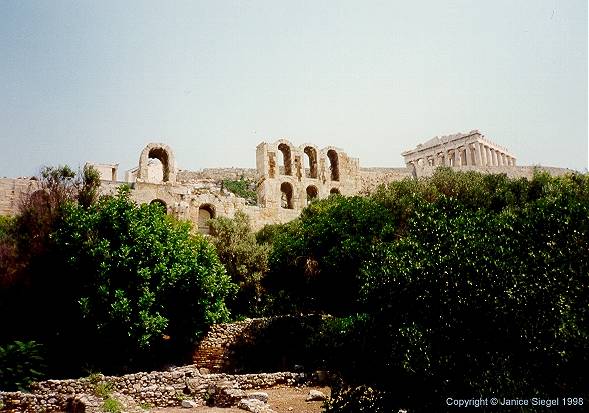
The Stoa of Eumenes is what remains of the colonnade built by Eumenes II, King of Pergamon (197-159 BC). It serves as a magnificent backdrop for the Odeum of Herodes Atticus, built in AD 160. The Roman writer Vitruvius says that the stoa served as shelter for spectators in inclement weather as well as storage space for scenery and sets. It is a typical Roman theater design, seating 5-6000: note that while Greek theaters lean into hills and become one with their environments, Roman theaters depend on man-made structures for support and backdrop. Amazingly, this auditorium was roofed in antiquity. The building was destroyed by the Hirullians in AD 267. The entire theater was refurbished in the 1950’s and is today used for theatrical performances during the summer Athens Festival.
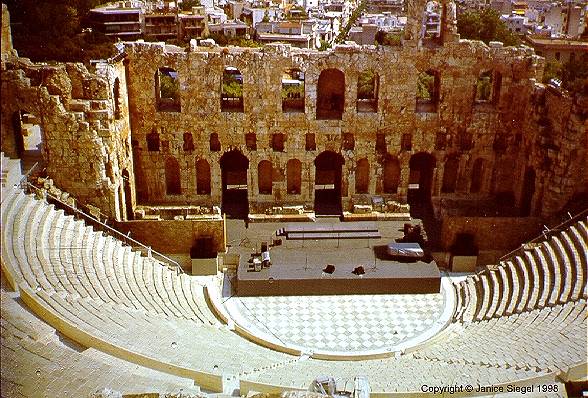
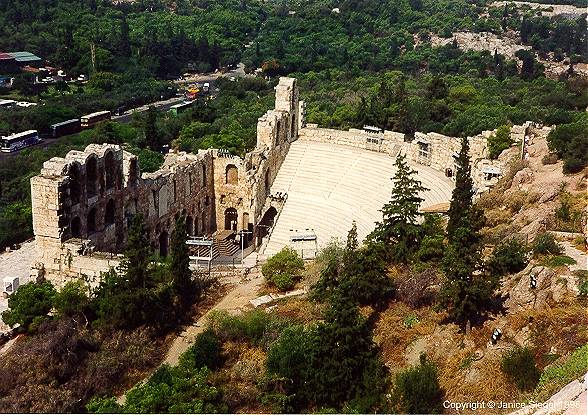
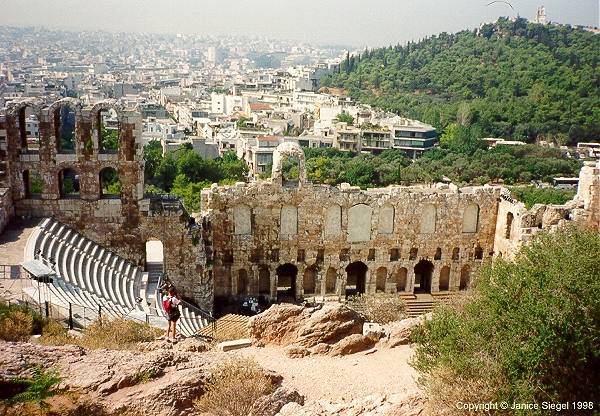
Herodes Atticus was a wealthy Athenian who spent his money on public works, among them this Odeum (or Odeion) in Athens for musical performances and the stadium at Delphi; he officiated as the Priest of Dionysus at the Panathenaic Festivals, and he was a sophist who counted Marcus Aurelius among his students. He has a generally spotless record with one exception. As the story goes, Herodes built this magnificent structure in memory of his dear departed wife, Regilla. But a story circulated that he had in fact killed her by kicking her in the abdomen when she was pregnant – but since he was able to point to the great expense he incurred building this memorial as proof of his love for her, he was never charged with a crime…