Originally presented at the National Gallery of Art’s 1997 Summer Teacher Insititute on Mythology.
The
Mythic Hero
an illustrated lecture
by Dr. Janice Siegel
The “mythic hero” is a particular breed of hero with particular traits. The Greek hero Heracles (Latin Hercules) will stand as our model Mythic Hero – since he exemplifies most of the associated traits – but we shall consider other mythic heroes from an assortment of cultures in our search to understand what exactly we mean by “heroic” in the “mythic” sense. Artwork used to illustrate these myths and heroes is deliberately drawn from a wide range of cultures, artists, periods and media to reveal the viability and popularity of such myths beyond antiquity.
Most fanciers of mythology are familiar with the old Pattern of the Hero, an attempt to boil down the main events of a hero’s life and career: for example, he is said to be of elevated parentage, exposed as an infant, adopted by poor foster family, has marvelous adventures, saves a princess from a dreadful fate, marries her, and eventually meets with a mysterious death…). This general pattern has been molded to fit various methodological approaches and there is little distinction – on a thematic level – to be made between patterns presented by Lord Raglan (myth-ritualist), Otto Rank (Freudian), and Joseph Campbell (Jungian). The pattern works well for the hero of folklore, but not for most mythic heroes, for it doesn’t necessarily include the single most important contribution of the mythic hero: insight into our sacred beginnings from which we have become alienated and with which we strive to reconnect. Mythology opens a door, an access way to what lies beyond our profane reality. The mythic hero can walk through that door and return to our world once again, while we cannot. So we depend on him to take that journey for us, and we hope to learn something about the cosmos and ourselves as a result of it.
I. HEROIC CONCEPTIONS
Because the mythic hero must be able to cross the boundaries that separate our world from that of the gods, to make accessible to mortals that wondrous but forbidden world, the mythic hero must have a mythic passport, i.e., divine parentage (something the established “pattern” waters down to include “royal parentage” ). This commingling of divine and mortal will allow him to act beyond the ordinary limits of humanity, an essential characteristic of the mythic hero. Divine conceptions of mythic heroes may be accomplished in several ways. The trickster-god motif is used by a god when he disguises himself as a woman’s husband in order to gain access to her sexually. She then has intercourse with her real husband and eventually gives birth to twins of different fathers. This is not an uncommon tale in classical mythology, but it does not offer any great opportunity to artists, since an illustration of the moment of such a heroic conception would show only what appeared to be man and wife. Heracles, the model mythic hero for today’s talk, is the product of such a union between his mother, Alcmene and Zeus, king of the Greek pantheon. Born Alcides, our mythic hero is the son of Zeus and is therefore half-divine; his twin Iphicles is the mortal offspring of Alcmene’s husband, Amphytrion. Heracles’ paternity will be a never-ending source of pain during his life, for as the bastard son of Zeus he will continually suffer in the throes of Hera’s jealousy.
Some versions of Leda’s story – another old chestnut – use the same trickster-god format: that Zeus lay with her in the guise of her husband, followed by her actual husband, and she then gave birth to two sets of twins, Helen and Clytemnestra and Polydeuces (or Pollux) and Castor, the first of each set being the divine child of Zeus and the other the mortal child of Leda’s husband Tyndareos. But another, more spectacular version of this heroic conception has been popularized by artists ancient and modern:
Hellenistic. Leda and the Swan (marble), n.d. Heraklion, National Museum
Correggio. Leda and the Swan, c. 1530. Berlin, Dahlem.
Flemish, After Leonardo. Leda and the Swan, early 16th c. Philadelphia
After Leonardo. Leda and the Swan, 16th c. Rome, Borghese
In this other version of the story, Zeus comes upon Leda in the form of a swan, and the children born of this union will be hatched from two eggs, each bringing forth a set of single-sexed twins. There is a rich tradition of hero shrines dedicated to the sons of Zeus, or Dioscuri (who eventually come to share Polydeuces’ divinity) and to Helen. Clytemnestra, of course, will earn another form of immortality when she murders her husband Agamemnon upon his return from the Trojan War. She will thereafter stand as the paradigmatic vindictive wife (and as to whether this is a just characterization or not is a completely different lecture).
Titian. Jupiter and Antiope, c. 1540 or 1560, Paris, Louvre
Watteau, J.A. Jupiter and Antiope, 1715. Paris, Louvre
Antiope also birthed a set of twins fathered by Zeus, this time in the form of a satyr. Amphion and Zethus become city-founders of Thebes, whose walls were made by stones moved by the music from Amphion’s lyre, a gift of Hermes. City-founding alone is enough to qualify one born of divine parentage for mythic hero status.
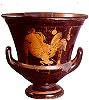
Greek, Attic: Kalyx Krater with Danae, 490-480 BC. St. Petersburg: Hermitage
Correggio. Danae, c. 1513. Rome, Borghese.
The story of Danae and her conception of the hero Perseus also offers a great opportunity for artists. Locked away by her father because an oracle claimed her offspring would cause his death, Zeus managed to find a way in to Danae anyway, in the form of a golden shower (Discuss…).
Titian. Danae, 1545. Naples, Capodimonte
Tiepolo. Danae and Jupiter, 1736. Stockholm University
II. HEROINES
What does it take, then, to be a mythic hero in classical Greek mythology? Does one need to embark on great adventures and be the dragon-slayer of great renown? No, although many mythic heroes do engage in such activities. This, however, is more of a folklore motif than qualification for mythic hero status. We must be careful to separate our preconceived notions of what makes a hero heroic from what the ancient cultures themselves demanded. Our list of classical Greek heroes might include the courageous Heracles, Perseus and Theseus, but a Greek’s would also have included city-founders, eponymous heroes (those who give their name to a region or people) and others as well. This is an important distinction, for few women would fit the paradigm of the “dragon-slayer”, yet there were actually as many female mythic heroes in the Greek tradition as male. To paraphrase Tristram Coffin, it is certainly more glamorous to grab a tiger by the tail than to pluck the feathers from a dead duck, and women simply did not have the opportunity (with few exceptions) to seek adventure in the manner of male heroes. Although the events of his life did not qualify a hero for mythic status, the circumstances of birth (as stated – divine parentage) and the reaction to his death are the qualifying factors. As we shall see, some form of immortality must be gained by the hero – in classical lore this is usually manifested by the hero having achieved cult status after death. Archaeological and epigraphical evidence (inscriptions) can be very helpful here – for example, even today you can still travel to Sparta and visit the Menelaion, a cult shrine dedicated to the worship of both Menelaus and his wife Helen.
But yes, the many classical Greek female mythic heroes tend to operate in a different way than their male counterparts, partly because of biology and partly because of social constraints. One of the premier differences might be summed up this way: men travel to places to establish themselves as heroes; women do it at home. Men found cities; women save them. Sacrificial heroism is based on the true evidence that human sacrifices were made to save cities, and the art and literature of antiquity provides details of particular instances.
Tiepolo, Giovanni Battista. Sacrifice of Iphigenia, c. 1750. J.B. Speed Art Museum
In some versions of her story, Ipheginia willingly goes to her death, sacrificing herself in return for a Greek victory in the Trojan War. In other versions, this child of Agamemnon and Clytemnestra is rescued at the very last moment by Artemis and becomes her priestess in Tauris. Artemis decreed that henceforth the clothing of women who die in childbirth would be dedicated to Iphigenia, affording her the cult status necessary for a hero to become mythic.
Roman. 1st BC (Pompeii). House of the Dioscuri. Perseus Freeing Andromeda. Naples
Titian. Perseus and Andromeda, 1555. London, Wallace Collection
Andromeda offers to die to appease a sea monster that threatens to destroy her father’s kingdom, a monster conjured up by Poseidon in punishment for her mother’s rash claim of beauty beyond the gods’. She is, of course, rescued and married to Perseus. Andromeda stands as a good example of how a sacrificial heroine’s actions generally gain our attention more because she provides a man with an opportunity to strut his heroic stuff (witness Perseus), rather than due to her own show of heroism.
The difference between male and female heroism in classical mythology is most clearly shown in the story of Alcestis. She willfully sacrifices her life for what she considers a greater good, the life of her husband. At the end of Euripides’ play, Heracles rescues her from her doom. While she is deemed heroic for submitting to Death, Heracles proves his heroism by wrestling Death. In the end, female heroes are less active and more reactive than their male counterparts, yet they were no less effective or celebrated in antiquity.
III. FEATS OF STRENGTH
But it is the male heroes who give us the sitting on the edge of your seat, cliff-hanger, action-packed adventure stories we so like – in Heracles, we have a figure who enjoys cult status after his death, but who also earned his reputation by engaging in many glorious and wondrous adventures. The twelve Labors of Heracles and his parerga (or side-adventures) form the bulk of the Heraclean corpus. Again, his connection with divinity is significant. Heracles becomes enslaved to his Uncle Eurystheus, a favorite of Hera, in a rite of purification for the murder of his first wife and child. It is Hera, of course, who is said to have caused the madness that overcame Heracles and caused him to kill his loved ones. The great hero, performing these labors at Hera’s instigation, will henceforth be known as Heracles, literally the “Glory of Hera.”
The ubiquitous use of Heracles’ labors in monumental sculpture proves its great significance in antiquity. Perhaps most famous are the metopes of the Temple of Zeus at Olympia, which we shall turn out attention to in a moment. Another panhellenic shrine whose many buildings sport Heraclean motifs is Delphi. Even on the Athenian Treasury (505 BC) the metopes depicting Heracles’ feats are outnumbered only by those depicting Theseus, the great Athenian hero, local boy done good. (Theseus’ story was rewritten in the 6th century to be more Heraclean – to universalize the Attic hero). Labors of Heracles are also depicted on the Siphnian Treasury at Delphi (1e BC); and the Heraclean frieze from the proscenium of the Theater of Delphi was dedicated to Nero, who identified himself with Heracles, and was visiting Delphi at the time of its completion.
The first six of Heracles’ Labors all take place in the Peloponnese (southern Greece) and are more folklorish than mythically heroic.
Greek Archaic (Psiax). Attic Amphora w. Hercules Strangling the Nemean Lion (from Vulci), c. 520 BC. Brescia, Museo Civico Romano
Heracles wearing lion-skin (marble) Treasury of the Athenians at Delphi, 500 BC. Delphi
The first labor – killing the Nemean Lion – is well-known for it is during this fight that Heracles acquires his most famous attribute, the lionskin he wears as a cloak. This labor stands as evidence of his great strength, for he must strangle this lion whose skin cannot be penetrated by a weapon. In fact, he must use the lion’s own claws to skin it.
Greek, Black-figured amphora: Heracles Attacking the Lernean Hydra with an Axe, early 5th century: Paris, Louvre
Antico. Rev. of Young Hercules Killing the Serpents: Hercules Killing the Dragon (Hydra) (bronze), N.D. London, Victoria and Albert Museum
The second labor depicts the dragon-slayer motif, typical of all folkheroes – the slaying of the Hydra from Lerna.
Raphael: Hercules and the Hydra (ink), circa 1507. British Royal Collection
The remainder of the first six labors all showcase some talent of Heracles. He shows his great endurance and speed by chasing for a year the Cerynean Hind, sacred to a virgin goddess (similar to the unicorn motif); he shows his great strength by capturing the Erymanthian Boar; brain wins out over brawn in his plan to clean the Augean stables – he simply re-routes a river; and he uses his wit to rout the dreadful Stymphalian Birds by making more noise than they do.
Antico. Hercules and Antaeus (bronze). N.D. Vienna Collections.
Cranach, Lucas. Hercules and Antaeus, 1530. Vienna, Gemaldegalerie, Akademie
Another feat which proves the great strength of Heracles is his fight against the giant Antaeus, who derived his strength from his Mother, Earth. Heracles had only to hold him off the ground and wait for his strength to ebb. Later ages (such as the Renaissance) tend to see Heracles’ victory over Antaeus as an allegorical victory of the sublime over the base.
IV. THE THREAT OF LIMINALITY:
While Heracles’ first six labors were meant to showcase the attributes of the hero, and were limited to a circumscribed area of the mainland, the next six involve far-ranging geographies and pit Heracles against metaphorical threats to culture and humanity, very common themes in Greek mythology.
We must remember that true mythologies – and therefore true mythic heroes – are the products of pre-historical and pre-literate societies and are, besides religious ritual, the only method of communication and instruction for the community. Limena, or thresholds, work both ways, and heroic victories over such forces underscore the double message: such behavior will not be tolerated from without or from within. In other words, it separates the kind of behavior that is acceptable and desirable from that which is considered dangerous to the society or culture. Males and females, for example, had very rigidly defined roles to play in Greek society and aberrations such as, for example, Amazons, caused great anxiety. Amazons are neither male nor female, civilized Greek nor true barbarian. Not coincidentally, each of the most prominent Greek heroes had a tumultuous encounter with an Amazon. Heracles went on a mission to retrieve the Golden Belt of the Queen of the Amazons, Hippolyta, and killed her in a battle instigated by Hera (slide – on the left).
Greek, Attic: Kantharos with Heracles and Amazons, circa 490-480 BC Brussels
Greek Archaic (Exekias). Attic Neck Amphora with Achilles and Penthesilea (from Vulci), c. 525 BC. London, British Museum
On the right, you see Achilles fighting Penthesilea on the battlefield at Troy. Theseus abducted the Amazon Queen Antiope, with whom he had a son Hippolytus, destined for ill perhaps because of his mixed parentage. The undeniable attraction felt for something at the same time inimical is revealed through both Achilles and Theseus falling in love with Amazon warriors they fight. It is said that Achilles (on the right) fell in love with Penthesilea even as he thrust his sword deep into her body.
Centauromachy. East pediment of Temple of Zeus, Olympia, 460 BC
The Centaurs constitute a similar threat to Greek society, and are similarly liminal creatures. There have been various explanations as to why the centaurs figure so prominently in the monumental sculpture of temples throughout Greece. Just as Amazons are a “weird conflation of man and woman”, Centaurs are neither beast nor man, but have qualities of both. As Dubois has discussed, both the Centaurs and Amazons were a primarily single-sexed society, ambivalent to and downright hostile to economically and socially necessary institutions such as marriage. Another good argument can be made for their identification with Persians, as the Greeks’ quite unexpected and fortuitous victory over the Persians ushered in the fifth century Golden Age of Greece, the era to which most monumental sculpture belongs. They have also been rightly perceived by Page Dubois as “anti-culture personified,” the most terrible of all threats to Greek thinking.
The most famous Centaur story of Greek mythology is the Battle of the Lapiths and Centaurs, or Centauromachy, as shown in this sculpture group from the East Pediment of the Temple of Zeus at Olympia. The Centaurs were invited to the wedding of the local Lapith king. They cannot hold their liquor (an example of a lack of control much disdained by the Greeks) and drunken revelry quickly escalates into full-blown combat as one of the lustful centaurs tries to abduct the Lapith bride. We note the central position the god Apollo has, providing divine guidance to the hero Theseus. These next slides show the same scene, but these are metopes which originally graced the Athenian Parthenon:
Greek,
Classical. Marble Metope 27, Parthenon. Centaurs versus
Lapiths,
c. 440’s BC, British Museum
Greek,
Classical. Marble Metope 30, Parthenon. Centaurs versus
Lapiths,
c. 440’s BC, British Museum
I particularly like this one because the penultimate scene of the battle is frozen in time. We do not know whether the Centaur or the Lapith (reaching for a rock) will prevail in the next instant. These above metopes are presently housed in the British Museum, but the photo below shows a plaster replica of a metope in situ (in its original place on the Parthenon in Athens).
Greek, Classical. In situ metope, Parthenon. Centaurs versus Lapiths, c. 440 BC, Athens
Heracles, too, has a run-in with a centaur. He kills the centaur Nessus:
Greek Archaic (Nettos Painter). Amphora with Heracles Killing Nessus, c. 620 BC. Athens National Museum #1002
Black-figured amphora Heracles Killing Nessus, 610 BC, Athens National Museum
Nessus has evoked the ire of Heracles by trying to abduct his wife Deianara. Nessus’ dying words convince Deianara that his blood has the power to engender love for her in her husband, when in fact it is a deadly poison that will burn off his skin. In fact, Heracles will later die by his enemy’s blood. Centaurs, those mysterious creatures of mythology, continue to capture the imagination of artists even today:
Rodin. Centauresse (bronze), 1889-90; cast 1970. Stanford University Museum
Masson. Traces of Centaures (gouache), 1943. Paris, Gallerie Louise Leiris
Perhaps it is our sublimated – and therefore potentially dangerous – desire to act like animals, to strip off our veneer of civilization, that explains the allure of these creatures of the deep forest, whom we also fear. Whatever it is, mythic heroes have the strength of mind and body to deny their power. Just as Amazons and Centaurs fail to fit into the paradigm of Greek society, all other hybrid creatures, threatening monsters which heroes must dispatch, fail to conform as well. They represent the same liminal threat to order.
Wounded Chimera from Arezzo (bronze, Etruscan), second quarter of 4th century B.C. Florence, Mus. Arch.
Bellerophon, for example, earns his reputation as mythic hero by killing the chimera, a triform of lion, goat and serpent, while riding on the back of Pegasus, the winged horse:
Greek, Attic fromVulci, The Siren Painter: Stamnos with Odysseus and the Sirens, c. 480 BC. London, British Museum
Odysseus cannot resist the opportunity of hearing the song of the Sirens (half bird, half woman); excited by the opportunity to hear their song filled with knowledge of the future, Odysseus acknowledges their great power – and his own inability either to fight his own nature or fend off their temptation – by lashing himself to the mast. His men, of course, all wear wax earplugs to protect them from being drawn in by the Siren’s song.
Greek, Archaic. Sphinx of the Naxians (marble), c. 560 BC, Delphi Museum
Ingres. Oedipus and the Sphinx, 1828. London, National Gallery
The Sphinx is another hybrid creature that strikes fear into the hearts of mortals. As we recall from Sophocles’ play, Oedipus is credited with answering the Sphinx’s riddle, upon which she slew herself. The slide on the left gives us a good view of its triform body. This was a votive offering of the very powerful island of Naxos, dedicated at Delphi. It is 2.3 meters high (about 11 feet), originally displayed on a column 12 meters high (four stories high). It has the head of a woman (with a typically archaic smile – it dates to 560 BC), chest and wings of a bird, body of a lion. On the right is Ingres’ representation of Oedipus solving the Riddle of the Sphinx. Click here for Dr. J’s Illustrated Oedipus and the Sphinx lecture.
The sphinx gives us a good bridge to the next threat often faced by mythic heroes, for the horror it generated was due to its indelicate habit of feasting on those who could not answer its riddles correctly. Anthropophagy – the eating of human beings – is a threat common to so many mythologies that it perhaps defines the paramount fear of humankind in this… dog-eat-dog world. One of Heracles’ twelve labors is to subdue the mares of Diomedes, which subsist on human flesh. Heracles tames them by feeding them their own master. Japanese mythology offers a roll call of heroes who are said to have vanquished the dreaded Kumo, a man-eating spider 120 feet in diameter in whose stomach the hero Raiko is said to have found 1919 human skulls. Yegara-no-Heida, another Japanese hero, is credited with downing Uwibami, a giant serpent whose habit it is to swallow men on horseback.
Feats of Theseus, interior of red-figured cylix, 440 – 430 B.C. London, British Museum
Labyrinth where Theseus Killed the Minotaur, Roman Mosaic, 4th century A.D. Vienna
Back in Crete, the Minotaur, which Theseus is credited with killing, feeds on the flesh of young Athenians provided in tribute. The Minotaur, by the way, also stands as warning against illicit sex, for he is the monstrous product of the unnatural union between a princess and a bull she lusts after.
V. THE THREAT OF ANTHROPOPHAGY
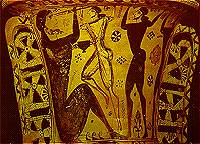
Greek, early (Orientalizing). Proto-Attic Amphora: Blinding of Polyphemus (from Eleusis), c. 670 BC. Eleusis Museum
Roman. 1st c. BC (Rome) The Odyssey Landscapes: The Attack of the Laestrygonians, 50-30 BC. Rome, National Museum
And who can forget Homer’s Odysseus, who struck a victorious blow for Greeks and all humanity by besting the anthropophagic Cyclops? But we can never relax – the danger of cannibals is never completely gone, as Odysseus himself finds out. In his very next adventure, Odysseus almost falls prey to the same threat, when he and his men enter the Land of the Laestrygonians, cannibals who falsely present a human – and humane – front.
Bandinelli: Hercules and Cacus (stone), N.D. Florence, at Palazzo Vecchio
Sundiata art?
On the way home from one of his labors, Heracles, too, faces a cannibalistic killer in Italy named Cacus who has much in common with Polyphemus the Cyclops, nemesis of Odysseus. Both monsters are the offspring of gods (Cacus, son of Vulcan, the Roman god of the forge; Polyphemus, Poseidon god of the sea); both are giants who live in caves that are man-traps; Cacus is characterized as a cannibal by the men’s faces which are nailed to his door. He also lies in a pile of half-gnawed bones. Not far removed from the horrors of the cannibalism of Odysseus’ Cyclops and Laestrygonians or Heracles’ Cacus lies Suamoro, the evil ruler in the West African epic Sundiata: he wears a robe and footwear made from human skin, reigns from a throne whose seat is human skin, and surrounds himself with the heads of the nine kings he has killed, depending on them to gain access to the spirit world. In these stories we see similar metaphors for threats to society, civilization, order, law and the continued existence of humanity itself.
VI. FIGHT AGAINST MORTALITY
Typically, the mythic hero will reveal his connection with the “other side” by ignoring the limits set on mortals by death or its sphere of influence. In cultures round the world, this momentary defeat of death is generally illustrated by a successful nekyia, or descent to the underworld. Heracles visits the underworld several times, and it was even the fulfillment of one of his labors: to bring back Hades’ three-headed watch dog Cerberus.
Greek, Archaic Ionian Hydria. Heracles Bringing Cerberus to Eurystheus (from Cerveteri), c. 530 BC, Paris, Louvre.
Ironically, on one visit to the underworld he betrothed himself to the woman – Deianara – who would eventually cause his own death. The underworld visits of Odysseus and Aeneas are faithfully chronicled by their respective poets, Homer and Virgil. These individuals learned important and useful information there, information they would not otherwise have had access to. This, too, is an example of mythic involvement. But the topos of nekyia is not restricted to classical Greece or Rome.
In fact, we can even look to the oldest hero myth on record, the Sumerian story of Gilgamesh, for an example of a mythic hero who stares death in the face – and bows to its great power and the fear it inspires. “Two-thirds divine” as the text purports him to be, Gilgamesh fulfills the basic requirements for heroic status. But distraught over the death of his faithful companion Enkidu, and terrified by the prospect of death, Gilgamesh embarks on a journey to learn the secret of eternal life, held by the goddess Ur-shanabi. He becomes the first to successfully get past the fearful Scorpion Men who guard the way to her dwelling (SLIDE).
Scorpion Man (sandstone) from Tell-Halaf in Syria
It is appropriate that the Scorpion Man should have a double form, as it stands as the guardian between two worlds. With the guidance of the goddess Ur-shanabi herself, Gilgamesh successfully harvests the life-giving plant that grows beneath the sea. It is stolen from him by a serpent, however, and in the end he abandons the pursuit for eternal life. The goddess’ words express the terrible truth of death: “Nobody sees Death,/Nobody sees the face of Death,/Nobody hears the voice of Death./Savage Death just cuts mankind down.” In alternate versions, Gilgamesh either gloomily accepts the idea of death as a permanent end for all mortal creatures, or he revels in the knowledge that he will live beyond his own time through the eternal fame of his monumental achievement, the great walls of the city Uruk. Although he reconciles himself to his mortal fate, perhaps the attraction of this hero is his initial passion to fight against his destiny. His eventual capitulation to the inevitable is a bitter pill to swallow – for him and for us. But something good does come out of this – we may be destined to die, but our passion to live only becomes stronger from the knowledge. This is the kind of essential knowledge – essential for psychic health – that we gain from the exploits of our mythic heroes.
Immortality – or the shuffling off of this mortal coil – can also be achieved in ways other than a descent to the Underworld. Odysseus faces this challenge at every turn – and the suggestion to leave all his troubles behind him becomes more appealing the farther in time and space he gets from his goal, which for Odysseus is home. The Lotus-Eaters, Circe, and Calypso all offer oblivion to Odysseus, a gift he rejects in favor of a familiar love and a lost life. Forgetfulness, immortality, drug-induced euphoria all offer the Easy Way Out we all wish we could take at some point or another. The gods may have immortality, but the heroes learn that it is only through action and achieving glory that life reveals itself to be valuable. Gods cannot act – they can only meddle in the lives of mortals. In fact, one could argue that the gods depend more on us for their existence than we do on them for ours.
Sun-Wukung, Monkey-Hero of Chinese Mythology. Illustration from children’s book
In the Chinese myth of Sun Wukung, the Stone Monkey, the character of Sun represents man and human nature, which is described as being prone to evil. Of supernatural origins (his stone egg was fructified by the breath of the wind), he was favored by the immortals and provided with extraordinary powers and abilities. He earned the name Wukung (Discoverer of Secrets) early in his career. Sun Wukung expresses his desire to achieve immortality in three most emphatic ways: he caused himself to no longer be subject to the Laws of Death by stealing down to the Underworld and removing his name from the Register of the Living and the Dead, he gained stewardship over the Garden of the Immortal Peaches and ate them, and three, he stole the pills of immortality guarded by yet another immortal. In a climactic battle seen in the above slide (left), Sun is finally overpowered by the immortals: Lao Chun (founder of Taoist system of philosophy) hurls his magic ring onto Sun’s head, while Ehr-Lang attacks and T’ien Kou (Celestial Dog) bites him in the leg. In the end, Sun is captured and when the immortals sentence this similarly immortal monkey to death, Sun threatens to destroy all Heaven. Buddha, summoned by the chief god out of desperation, thoughtfully asks Sun why he wants to possess the Kingdoms of heaven. Sun arrogantly replies, “Have I not power enough to be the God of Heaven? My qualifications are innumerable. I am invulnerable. I am immortal, I can change myself into 72 different forms, I can ride on the clouds of Heaven and pass through the air at will, with one leap I can traverse 108,000 li (36 thousand miles).” Buddha soulfully declares that Sun could not even jump out of his hand. Not one whose ego would allow him to turn down a dare, Sun jumps and easily reaches the farthest pillars of the created universe. He signs them as proof of his visit, only to find upon his return that these pillars were the Buddha’s own fingers, and that he indeed never left Buddha’s hand. In place of eternal incarceration, the vanquished Sun chooses to embark on the journey to the mythical Western Paradise to seek the sacred scrolls, a journey filled with dragons, cannibals and mythic temptations, an allegorical dramatization of the introduction of Buddhism into China.
Sun’s desire to appropriate the The Peaches of Immortality reminds us of Adam and Eve being denied access to the Biblical Tree of Life after their Fall, as well as Heracles’ labor to collect apples from the Garden of the Hesperides:
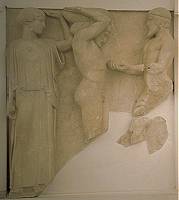
Greek, Classical. Temple of Zeus, Olympia. Metope of Atlas and Heracles, 460 BC. Olympia Museum
Italian, 16th c. (Florence). Farnese Hercules (bronze). National Gallery of Art, Washington, D.C.
The apples were guarded by a dragon in a walled garden somewhere at the ends of the earth, the exact location known only to the Titan Atlas, shown on the right returning with the Apples in this fabulous metope from the Temple of Zeus at Olympia. Heracles, the greatest of heroes, is barely able to support the weight of the sky, while the goddess has only to raise her left hand to relieve his burden. In contrast, note the confident posture of the Renaissance hero on the right, shown alone with his prize, leaning on his club, over which he has draped his lion skin.
VII. THE UNHEROIC HERO
In a confusing twist, Heracles and other mythic heroes often surprise us by performing selfish and dastardly deeds, or acting in remarkably unheroic ways. How do we account for this? A hero is not a do-gooder who runs around looking for damsels to save. A hero is a semi-divine being, wondrous in his attributes and abilities, who continually seeks ways to achieve the glory he considers his due. Therefore, a hero is not necessarily a paragon of virtue. Although often the savior of a damsel in distress, the mythic hero just as often is “guilty of striking departures from the morality of his society.” We revel in the hero’s exploits because he is a mirror of ourselves – our great potentialities and the great limitations set for us by nature, society and each other. Heracles’ glory is that he continually tries to overcome the limitations set on him by Hera, by Eurystheus, by the very laws of the universe – and he never gives up. As Waith puts it, “his exploits are strange mixtures of beneficence and crime, of fabulous quests and shameful betrayal, of triumph over wicked enemies and insensate slaughter of the innocent, yet the career is always a testimony to the greatness of a man who is almost a god – a greatness which has less to do with goodness as it is usually understood than with the transforming energy of the divine spark.” In other words, we admire that quality of the mythic hero – arete – that “embodies his conquering spirit, the energy that permeates everything he does”. Thus, the hero is “an odd combination of terrifying excesses and superb self-mastery”.
Roman Mosaic, Roman Villa near Antioch: Heracles and Dionysus in a Drinking Contest, 3rd century A.D. Princeton Art Museum
Here, for example, Heracles is shown engaged in a drinking contest with none other than the god of the vine, Dionysus. Of course, for no mere mortal could ever best Heracles in anything. Heracles’ reputation for drinking was also a favorite theme for playwrights, and not only comic ones – Euripides portrays him as quite the drunken buffoon in Alcestis, as he stumbles into the mourning household, loudly demanding to know why everyone looks so sad. He does, of course, eventually act “heroically” and save the damsel from death.
As we know, after murdering his first wife and their children (the madness said to have been caused by Hera), Heracles seeks purification and is told to serve his uncle Eurystheus, who assigns the Twelve Labors. Later, the unjustifiable murder of Iphitos, a clear violation of xenia, or guest-host relations, causes Heracles to seek purification again. Denied such by Apollo at his shrine at Delphi, Heracles oversteps his bounds and tries to wrestle Apollo’s sacred tripod from him. In punishment, Heracles is sold into slavery for one year to Omphale, Queen of the Lydians.
Hercules and Omphale, 1724. Paris: Louvre
This painting by Lemoyne shows the hero in a completely feminized state, apparently part of his punishment (discuss slide). Such apparently unheroic behavior does not cause us to lose faith in our mythic heroes who prove themselves to be both wonderful and terrible. In fact, their faults are simply magnifications of our own and highlight the limitations of those of *us* born mortal, too.
VIII. IMMORTALITY ACHIEVED
Although the mythic hero enjoys a victorious battle against death now and again, in the end he must necessarily lose the war. Death is a necessity, for the mythic hero must suffer the same limitations regarding mortality that we do, or his appetites become vulgar excess, his pride hubris, his single-mindedness of purpose, egotism. Just as important for mythic hero status is the hero worship that follows after death. Classical Greek and Roman heroes had this stage of their existence defined in terms of hero cult, ritualistic religious worship of the hero after his death, and Heracles certainly had more than his share of dedicated cults. But Heracles is an unusual example of how a mythic hero can achieve immortality, for he actually undergoes apotheosis, becoming a god. Other classical mythic heroes to be so honored are Ino, who becomes Leucothoe, and then the Roman Psyche, whose new mother-in-law, Venus, demanded that her son Cupid not marry a mere mortal.
Heracles’ death on the funeral pyre he himself builds represents man’s almost frantic desire to break free from the constraints of mortal existence, and his eventual apotheosis shows the hero’s ability to transcend his mortality, but only with the help of the gods. Heracles’ mortality – a mere fraction of our own – is enough to drag him down – only with the help of the divinity can he attain immortality, a theme constant in the mythic foundations of many religions, and a solace to human beings in their knowledge of their mortal limitations. In Heracles’ case, he had thrown himself on a funeral pyre to escape the torment of the centaur Nessus’ poison blood on his shirt, innocently provided by his wife Deianara, who hoped only to preserve his love of her. After the body of Heracles was burned on the fire, Zeus extinguished it and proclaimed that only the mortal part of the hero had been consumed, while his immortal part was going in a chariot to Mt. Olympos.

Tiepolo, Giovanni Battista. Triumph of Hercules, c. 1761. Currier Gal. Art
Landscape, Valley of the Muses, Mount Olympos, 1995. Greece
There he was proclaimed the twelfth Olympian, reconciled with Hera and united in marriage with her daughter Hebe, goddess of youthful beauty, who gave him a drink of the gods’ immortalizing nectar. Compare Tiepolo’s artistic rendering of this scene with a photograph of the real summit of Mt. Olympos, on the right, a picture I took myself.
A mythic hero from yet another tradition of a later age earned a similar sort of immortality by destroying a poison-belching monster wreaking havoc on yet another innocent community:
van der Weden. St. George and the Dragon (wood), c. 1432. National Gallery of Art, Washington, D.C.
Raphael. St. George and the Dragon, 1504/06. National Gallery of Art, Washington, D.C.
In the story of St. George and the Dragon, the real horror is that the townspeople have resorted to sacrificing a few children a day to the greedy monster in vain hopes of forestalling total destruction, reminiscent of the Athenians paying tribute to Crete in the form of boys and girls to feed the minotaur. Similarly, the Japanese hero Susanowo has to kill the terrible eight-tailed dragon of Kosi, also used to feeding on human children tearfully provided by the townspeople. Anyway, on his way to join his legion, the Christian soldier St. George comes upon the scene at the very moment that the king’s daughter, Cleodolinda, approaches the feeding zone. There is hope that her heroic sacrifice will once and for all satiate the beast. Although urged by her to stay at a safe distance, St. George promises to deliver her “through the power of Jesus Christ.” His successful battle inspired the populace of 20,000 to be baptized at once. For his sanctity, St. George was beheaded under the 303 AD edict of Diocletian, which outlawed and called for the persecution of Christians. Worshipped in the East from that time, St. George’s popularity only reached similar heights in Europe nearly 1000 years later during the time of the Crusades. Both of these representations of this Christian myth are on display in the West Wing of this gallery. On the left is a fifteenth century painting on wood by van der Weyden, and on the right, Raphael’s 1504 representation. Each painting includes the essential details which allow us to see St. George as not only an early Christian knight, but as mythic hero as well. All the popular folklore elements are here – innocent princess to be saved, horrible dragon to be slain, the fearlessness of the sacrificial heroine, the hero on his trusty steed, and pieces of unsuccessful heroes strewn about, but it is St. George’s belief in a divine force from which he derives his strength and ability, that elevates his feat and his character into the realm of the mythic and grants him success where those before him failed.
Sodoma’s St. George and the Dragon
Cornelius van Haarlem: Two Followers of Cadmus Devoured by a Dragon, 1588. London: National Gallery
Cornelius van Haarlem’s representation of would-be dragon slayers (Cadmus eventually kills it) picks up on the theme of the hero as victor where those before have failed, although a bit more graphically than van der Weyden (discuss slide). In terms of mythic heroes, canonization is equivalent to hero cult, breeding the same ritualized worship: one only has to tour Greece or any other country influenced by the East and see the sheer number of shrines dedicated to the worship of Saint George to understand his religious influence.
The bestowal of mythic status can also work in reverse. Historical leaders have often adopted heroic personae (and in the case of Augustus, a divine one). In the desire to achieve prestige and power beyond that afforded mortal men, with the final goal being immortality, Alexander the Great and Napolean both had themselves depicted in official portraitures with the attributes of semi-divine heroes. This is general practice among Chinese political leaders even in the historic era. Our own George Washington, a genuine American historical personage, soon gained mythic status in terms of folklore: tales depicting him throwing a silver dollar across the Potomac suggest supernatural strength, for example, and the cutting down of the cherry tree story suggests a noble and elevated morality. Washington was credited with achievements beyond our ken, an entering into that mythic reality beyond our human existence. This, of course, reflects well not only on George, but on our country and therefore on us as well. The transformation of Washington’s character may have started with the idea that he was a better-than-average man, but it culminated in the actual suggestion of apotheosis, as depicted by Constantine Brumidi in the fresco which decorates the dome of the Rotunda of the Capitol Building here in Washington. So there is no mistake about its import, the painting is entitled The Apotheosis of George Washington, in which GW takes his place among the immortal Olympians:
Brumidi, C. U.S. Capitol, Dome, The Apotheosis of George Washington, 1864. Washington D.C.
Flanked by the figures Liberty and Victory, the deified president rises to the heavens, encircled by thirteen maidens representing the original States, suggesting divine approval of not only George, but of his vision of America as well.
Brumidi, C. U.S. Capitol, Dome, The Apotheosis of George Washington, 1864. Washington D.C. (detail)
Brumidi, C. U.S. Capitol, Dome, The Apotheosis of George Washington, 1864. Washington, D.C. (detail)
Six groups around the perimeter combine classical gods with important figures in American history: the goddess of agriculture, Ceres, rides a reaper through fields of golden grain while the figure of Young America looks on; the god of smiths, Hephaestus, stands among cannons and cannonballs; messenger god Hermes offers a bag of gold to Robert Morris; Poseidon and Aphrodite emerge from the sea, holding the Atlantic cable; and Athena imparts wisdom to the greatest American inventors of that time (Franklin, Morse, Fulton).
I conclude with some words about the recent explosion of pop culture treatments of classical mythology. Several mythology-based productions – the enormously popular Hercules (not to mention Disney’s version), Armand Assante’s Odysseus, the completely fictitious Xena, the Warrior Princess, and the recently re-released Star Wars trilogy, purposely modeled after the mythic hero and company – speak to our society’s yearning for a way to reconnect with that other, lost world. But we are so removed from our mythic beginnings that we cannot conceive of a hero who can walk among us – of one who can at one and the same time exist in two worlds, the sacred and the profane, or if you prefer, the mythic and the real. In a misguided mythic striving, we create SUPER heroes, those who function ABOVE the level of humanity. Every single 20th century American mythic superhero schizophrenically sports a double identity – that of his hero and that of his “cover.” The arch criminals our superheroes fight are enemies of society no less fearful than Heracles’ Hydra or Theseus’ Minotaur, but these modern heroes must transform themselves before they can act. They peevishly protect their alter-ego identities, for modern society threatens to squelch their mythic power. Their human personae lack the power to act, but provide the superhero with the access to a reality which accepts/appreciates/needs mythically heroic behavior. Batman owes his very existence to Bruce Wayne, Spiderman to Peter Parker, Wonder Woman to Diana Prince. They all fear being exposed, for their power is in their mystery, as well as in their abilities and moral codes. Which is more attractive to you? Superman’s ability to fly, see through solid objects and run faster than a speeding bullet (a Freudian would see these as wish-fulfillments) or his unwavering adherence to Truth, Justice, and the American Way? All superheroes transcend our puny human reality at will, and when we engage in their stories, for a while, at least, we can too. It is this sense of wonder and mystery they bring to our lives – and the glimpse it offers of a nobler, more profound existence – that we most cherish. We recall the reason heroes exist in the first place – to stand as models of courage and persistence in our journey through life, a journey fraught with all manner of perils and pitfalls, and as we engage in our own struggle, we remain determined in our pursuit to continue the search for that missing mythos.
Bibliography: Mythology In Art
Green,
Miranda Jane. Celtic Myths. British Museum Press: London, 1993.
Jacobs, Michael. Mythological Painting. Mayflower: NY, 1979.
Mann, A.T. and Jane Lyle. Sacred Sexuality. Element Books: Mass,
1975
McCall, Henrietta. Mesopotamian Myths. Bath Press: Avon, 1990.
Reeder, Ellen D. Pandora: Women in Classical Greece. Princeton
UP: Princeton, 1995.
Bibliography: The Hero in Mythology
Brombert,
Victor. The Hero in Literature.
Campbell, Joseph. The Hero With A Thousand Faces. Princeton UP:
Princeton, 1949.
Coffin, T. P. The Female Hero in Folklore and Legend. Seabury
Press: NY, 1975.
DuBois, Page. Centaurs and Amazons. U of Michigan Press: Ann
Arbor, 1991.
Dumezil, Georges. The Destiny of a King. U of Chicago P: Chicago,
1971.
Dundes, Alan. “The Hero Pattern and the Life of Jesus,” in In
Quest of the Hero. Princeton UP: Princeton, 1990.
Kirk, G.S. Myth: Its Meaning and Function. U of California Press:
Berkeley, 1970.
Kirk, G.S. The Nature of Greek Myths. Penguin: NY, 1974.
Knapp, Bettina L. Women in Myth. SUNY Press: NY, 1997.
Leeming, David A. Mythology: The Voyage of the Hero. Harper and
Row: NY, 1981.
Lyons, Deborah. Gender and Immortality: Heroines in Ancient Greek
Myth and Cult. Princeton UP: Princeton, 1997.
Morford, Mark and Robert Lenardon. Classical Mythology. Longman:
NY, 1995.
Puhvel, Jaan. Comparative Mythology. Johns Hopkins UP: Baltimore,
1987.
Lord Raglan. The Hero: A Study in Tradition, Myth, and Drama.
Methuen: London, 1936.
Lord Raglan. “The Hero: A Study in Tradition, Myth, and Drama, Part
II,” in In Quest of the Hero. Princeton UP: Princeton, 1990.
Rank, Otto. “The Myth of the Birth of the Hero,” in In
Quest of the Hero. Princeton UP: Princeton, 1990.
Segal, Robert. “Introduction,” in In Quest of the Hero.
Princeton UP: Princeton, 1990.
Slater, Philip. The Glory of Hera. Beacon Press: Boston, 1968.
Werner, E.T.C. Myths and Legends of China. Sinclair Brown:
London, 1984.
copyright
2001 Janice
Siegel,
All Rights Reserved
send comments to: Janice Siegel (jfsiege@ilstu.edu)
date this page was edited last:
11/26/2005
the URL
of this page:
https://people.hsc.edu/drjclassics/lectures/mythichero/mythichero.shtm