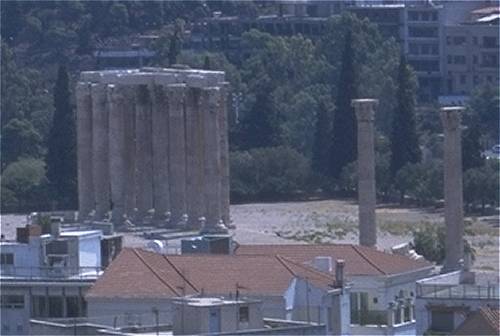
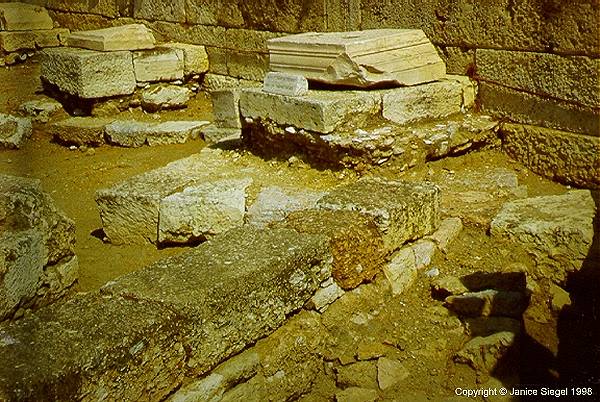
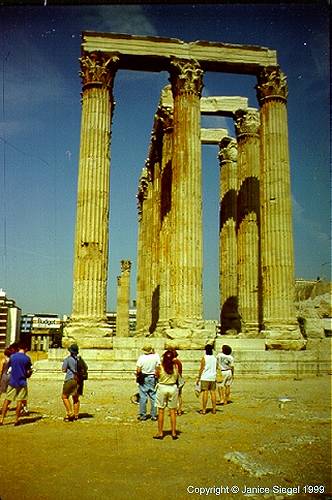
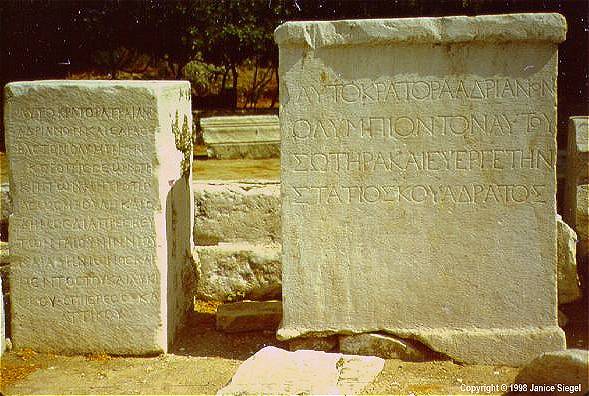
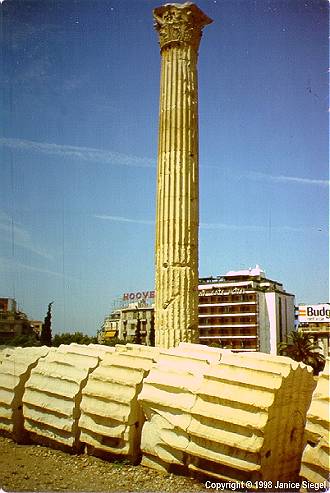
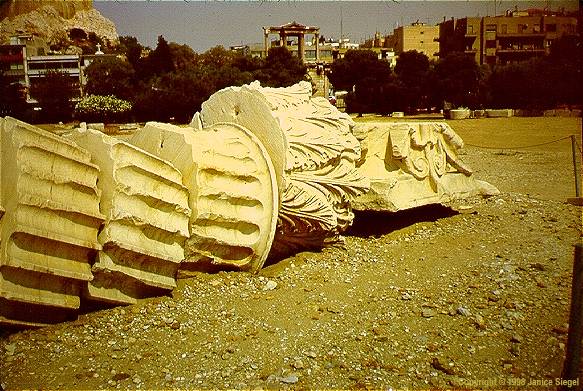
This area south of the Acropolis has been sacred since Mycenean times, when it and the Acropolis itself composed the whole of the city of Athens (until the time when Theseus is credited with unifying Attica). There are many ancient shrines here: a temple to Rhea and Kronos is thought to have been built on site and Deucalion is said to have built the first Temple of Olympian Zeus on this very spot after surviving the flood. In fact, Pausanias (1.18.7) claims that a chasm several feet across in the ground on the site is where the flood waters drained away. Next to build on the spot was Peisistratos, the 6th century Tyrant of Athens. No more than the basic foundation can be traced to his era. Peisistratos had planned his temple to be as large as any temple in Greece, and in the Doric order (there is evidence of corner contraction and massive column drums). In the Politics (E 1313b 18-25), Aristotle uses the Olympieion of the Peisistratids as an example of how tyrannies engage the populace in great works for the state and keep them in such poverty that they have no time, energy or means to rebel. But when the last tyrant, Hippias, was expelled in 510 BC, work ceased on this monument to tyranny. Many of the unfluted column drums were even incorporated into the Themistoclean Wall, parts of which can still be seen on site. Then, of course, came the Persian Invasion, after which the Athenian workforce and all state funds were directed to Pericles’ Building Program on the Acropolis. The Hellenistic King Antiochus Epiphanes (174-165 BC) took up the construction project next, but he died with the project “half-finished,” writes the geographer Strabo. The architraves and capitals are certainly Antiochus’. But when Antiochus died, work on the temple stopped again. In 86 BC, Sulla took two columns to Rome to build Jupiter Capitolinus (the Temple of Jupiter on the Capitoline Hill) (Pliny, Natural History 36.45). These columns may have influenced the Corinthian style in Rome. 700 years after it was begun, Hadrian finished it, and the finished product would have met with Peisistratos’ approval, for it is indeed (or was, when intact) one of the largest temples in Greece, with 104 columns, including a triple row of columns on the East and West ends, double rows on the North and South ends, and 4 more inside the antae. It was, however, finally built in the Corinthian order according to Antiochus’ plan, not the Peisistratids’ Doric design. This causes the temple to appear a bit bulky: a Doric design would have had thinner and plainer columns, as opposed to the thicker and busier Corinthian capitals with acanthus leaves. Pausanias says that Hadrian practically exhausted the supply of marble on Mt. Pendeli building it (1.19.7). The original Peisistratid design called for limestone. In AD 130 Hadrian dedicated the temple itself, the chryselephantine statue of Zeus inside it (a copy of Pheidias’ Olympia statue), and a statue of himself. Hadrian associated himself closely with Olympian Zeus, and the sacred precinct was positively littered with statues of Hadrian sent from all over the Empire. Pausanias (1.18.6) tells us that only the colossi at Rome and at Rhodes were bigger than the cult statue of Zeus. Five inscriptions have been found on site at the Olympeion. One, dated AD 132, reads: “Statios sets up the [statue of] Hadrian to honor the Emperor Hadrian.” Another, dated to AD 138, refers to this same Statios as a priest of the cult of Hadrian. So if there were 104 columns in the finished temple, why are there only 16 now? Most of them were probably carted away as building materials in the ages following Roman occupation. Post-antiquity column counts have been gleaned from travelers’ reports: in the 15th century there were 21 columns; in 1765 there were 17, but a Turkish governor melted one down in a lime kiln to build a mosque. Legend has it that the remaining columns mourned the loss of their sister until the Turkish governor was killed by poison. Then there were 16, and one of these came crashing to the earth during a thunderstorm on 26 October 1852. The fallen column offers an up-close look at the detail: it has 24 flutes and a Corinthian capital with acanthus leaf. Dowels are set through the middle of individual drums, indicating that these holes were for positioning, not structural support. Metal dowels on the sides of the columns, held in little niches, kept the drums in place; chisel marks are mute evidence of scavengers extracting the metal clamps, which they then melted down and made into ammunition.