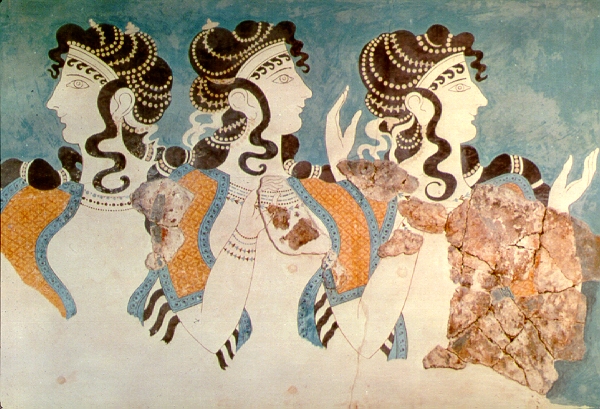
Cnossos (Knossos), near modern Heraklion, was the largest and most important palace of Minoan Crete, first excavated by Sir Arthur Evans beginning in 1900. Occupied from Neolithic times, its first palace was built around 1900 BC and rebuilt after an earthquake around 1700 BC into the sprawling, multi-story complex whose remains, and Evans’ controversial concrete reconstructions, are visible today. The palace’s maze-like plan of interconnected rooms, storage magazines, and light wells gave rise to the Greek myth of the Labyrinth, built by the craftsman Daedalus to house the Minotaur, half-man and half-bull, at the command of King Minos. Excavations uncovered vivid frescoes (including the famous “Bull-Leaping” fresco), massive storage jars (pithoi), and the clay tablets bearing Linear B, the earliest known form of written Greek. [Editor’s note: no old-site source material was found for this page. This paragraph was drafted as a placeholder using general reference sources and should be reviewed/expanded by Dr. Siegel.]
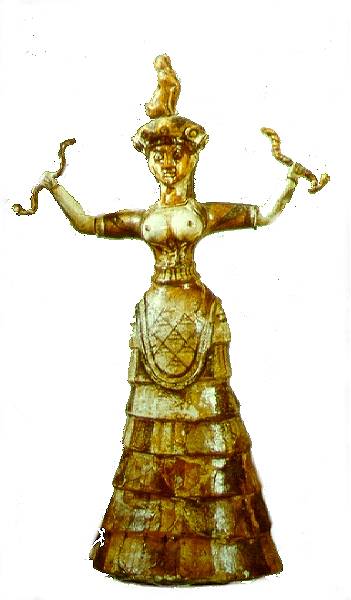
Faience Snake Goddess, Knossos, 16th century BC, Heraklion Museum
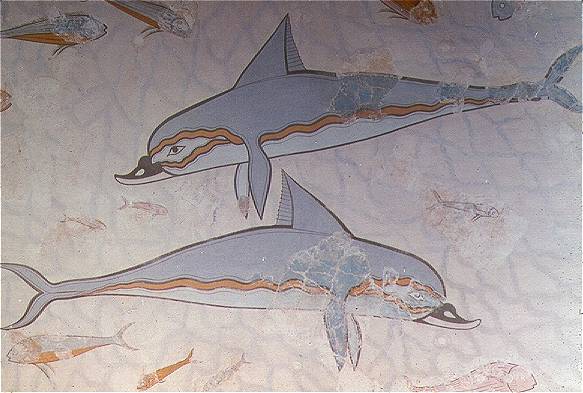
Dolphins fresco, Queen’s quarters, Knossos, Heraklion Museum
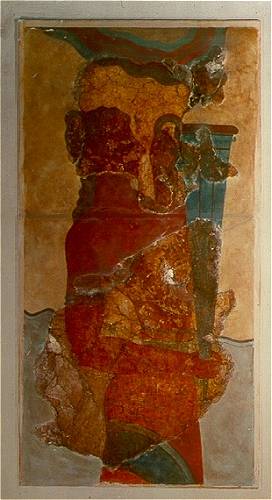
“Rhyton-Bearer” fresco, Knossos, Heraklion Museum
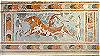
“Bull-leaping” fresco, Knossos, Heraklion Museum