Dr.
J’s Illustrated Archaic Age
color-coded
Timeline/Lecture
war
literature/theater
politics
science/philosophy
Panhellenic
Festivals
It turned out to be more difficult than I thought to assign colors to various aspects of Greek history. And this speaks to the very nature of ancient Greek culture: spheres of influence were not so easily divisible in ancient Greece as they are for us. The Greeks had an uncanny facility to move easily from the sacred sphere to the political to the domestic… it makes me mourn the loss of that totality of experience in our own culture. Back then, kings consulted religious Oracles on matters of State, athletes at Panhellenic Games sought glory for their home cities from the particular Olympic god to whom the games were dedicated, and the God Dionysus himself – in the figure of his cult statue – presided over theatrical competitions in fifth century Athens. Is Attic theater an artistic invention? A political tool? A religious event? All of the above. How can we define “philosopher”? The cosmologist Pythagoras attracts a religious following; Socrates becomes a political subversive; Aristotle invents literary theory. What an amazing time, and what amazing people.
The Archaic Age is characterized by a Greek spirit of unity not quite strong enough to unite the cities politically, but definitely strong enough to remind them of their common bond. This busy time has been described as The Age of Aristocracies, The Age of Expansion, The Beginning of the Western Literary Tradition, and the Age of Law-Givers. The first thing we notice is that there are no really big wars in this age, and people are busy developing culture: Panhellenic Festivals, theater, law codes, literature, democracy, and early Greek science and philosophy all hark back to the Archaic Age.
Age of Aristocracies
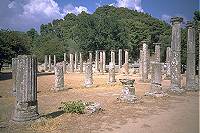
The Archaic Age is best known as the Age of Aristocracies, because its developing poleis (city-states) are characterized by a rejection of the old-style monarchies of the Mycenean Age (as dramatized in later plays you may have read such as Aeschylus’ Agamemnon and Sophocles’ Oedipus). The Archaic Age is also characterized by the development of Panhellenic Centers, one of the first signs that Greece is coming out of the previous period, known as the Dark Age. The destruction of Mycenean civilization caused a fearful time in which the Greeks of each area kept to themselves (which is very easy to do in Greece since the mountainous topography naturally isolates each habitable area from the next). The establishment of the Panhellenic (“All-Greece”) Festival at Olympia (in honor Zeus) is the first sign that Greeks are beginning to communicate and interact with each other again. They came from all over to compete for the honor of their home city-state. OLYMPIA is a city in the Peloponnesus (southern part of Greece), named in honor of Zeus, King of the Olympian gods; don’t confuse it with MT. OLYMPOS, the mountain home to the OLYMPIAN gods. On the left is a photo of the Palaestra at Olympia, where the athletes practiced, although the ancient competitions were not restricted to athletic events, as they are today.
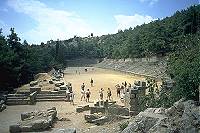
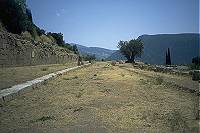

In 582 B.C. the Pythian Games are established
(honoring Apollo at Delphi). On the left is the
stadium at Delphi, on the right, the training area
for athletes. The poet Pindar will make the games
famous in his collection of Pythian Odes. Actually,
Pindar writes a collection of Odes for each of the
celebrated Panhellenic sites. In 573 B.C. the Nemean
Games are established (honoring Zeus at Nemea). In
the center above is a photo taken from inside the
covered tunnel entrance to the stadium at Nemea. It
is the only Panhellenic site to have retained its
tunnel intact. And
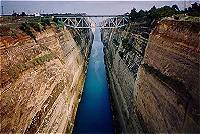
about a decade later (560’s B.C.) the Isthmian Games are founded (honoring Poseidon at Isthmia). “Isthmia” is where we get the word “isthmus” – this is the city on the bridge of land that joins the southern land-mass of Greece, the Peloponnesus, with Sterea Ellada, or Central Greece. Today, ships can sail right through the Corinth Canal (photo on right), but in antiquity, boats had to be dragged across a mile-wide strip of land called the Diolkos if they didn’t want to have to sail all the way around the southernmost tip of Greece.
Age of Expansion: 750-550 B.C.
From 750-550 B.C., Greek civilization revitalized. In response to rapid population growth and a lack of arable land (grapes and olives are about the only crops that thrive), a new breed of Greeks sets out to discover or forge a new world. Colonists ranged far and wide, east to the Ionian Coast of Asia Minor, South to the northern shores of Africa, and west to Europe: Marseilles was originally a Greek colony, and Sicily and southern Italy has so many settlements on it it was known as Magna Graecia, or “Big Greece.” Many of these settlements opened trade routes for Greece that helped them become a world player in the centuries to come. (Temple students, see your map on page 12 of your IH Source Book – all the shaded areas are colonies dating to this period.)
The photos above (well, they will be soon!) are of Paestum (originally called Poseidonia) in Italy, a Greek colony founded by Greeks from Achaea (mid-Peloponessus) in honor of the god of the sea, Poseidon. These are some of the most breathtaking archaic temples that exist today. On the left, a temple to Hera, on the right, one to Demeter, and the temple in the middle – under the tent – is dedicated to Poseidon.
The Western Literary Tradition begins with poetry
The Western literary tradition begins with the works of Homer and Hesiod, dating to the mid 8th century B.C. The epic poet Homer codified and wrote down the stories of the Trojan War (in his Iliad and Odyssey) told orally for hundreds of years since the actual war was fought (ca. 1250 B.C.). The didactic poetry of Hesiod (author of Theogony and Works and Days) links everyday life (especially for farmers) with the world of the gods. Both authors are throwbacks to an earlier time, the long-lost Mycenean Age (Bronze Age) when gods and man walked the earth together (thank you, Xena…) and all Greeks were a unified force and a more homogenous culture (i.e., it was all Greeks against a common outside enemy, the Trojans, back then, not one Greek against Greek another).
But the Archaic Age, on the other hand, is witness to the development of individually distinguishable city-states. And it is this strain of individuality and self-expression that paves the way for the next literary development, the lyric poem. The lyric poets flourished in the newly colonized Asia Minor shoreline and islands in the late 7th century B.C. (the lower 600’s B.C.). Sappho’s birthdate, for example, is estimated at ca. 610 B.C. Greek lyric poetry offers an alternative to Homer’s epic or Hesiod’s didactic poetry. While epic poetry reflects the totality of a culture, lyric poetry is more concerned with communicating personal sentiment – feelings of love, grief, friendship, etc. The lyric poetry of Sappho and the other famed eight lyric poets of her age provides a personal voice new to Greek literature and imitated by generations of poets thereafter.
Age of Law-Givers 621 – 594 B.C.
The last half of the 7th century B.C. is known as the Age of Law-Givers in Greece. Draco’s Law Code in Athens in 621 B.C. caused tradition and custom to become written law for the first time. This is a photo of the Law Code of Gortyn (SOON!), in Crete, but Draco’s Law also would have been similarly carved into stone and publicly displayed. Draco’s Code was considered harsh, but his goal was to lessen the discrepancy between the haves and the have-nots, economically speaking. But despite Draco’s attempts, poor people still suffered at the hands of unscrupulous land-owners and people had gripes. Often there were spontaneous revolts by the underprivileged classes who could no longer bear the burden of their place in society. The stage was set for some serious reform.
Enter Solon the Law-Giver in 594 B.C. Solon, one of the proverbial Seven Ancient Sages, did not hail from Athens, or even from mainland Greece. He was one of the traveling wise men who learned lessons from the way varied cultures handled their challenges. Solon was given the power to re-distribute the wealth across the board, providing welcome opportunities for society’s have-nots. Many farmers did not own the land they worked in the first place, or they accrued debts they couldn’t pay and became sharecroppers as a result. Solon cancelled or reduced debts and redistributed the land, restoring property to many. Solon encouraged the production and export of olive oil, lured foreign craftsmen with the promise of citizenship, and made it a law that all fathers should teach their son a trade. The Athenian pottery business grew from this edict, and it explains why Athenian pots are found all over the Mediterranean and beyond. Solon single-handedly created a merchant class. He also created the first citizen-manned courts, giving the people valuable experience in self-government.
Age of Tyrants in Athens: 561 – 510 B.C.
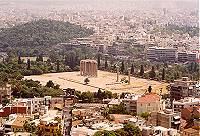
Pesistratus becomes Tyrant of Athens. Back then, “tyrant” just meant something like “the buck starts and stops here” – he was the sole ruling body in the land, an aristocrat’s aristocrat – not necessarily a cruel and megalomaniac ruler. Although totalitarian about making laws, Pesistratus did have Athens’ interest at heart. Under his rule, the city prospered: he built an aqueduct, redistributed confiscated land, helped poor farmers. Characteristic of tyrannical rule is the desire to build monumental edifices, proofs of the tyrant’s power. The Temple of Olympian Zeus, right, was designed to be the largest temple in Greece (remember – the Parthenon won’t be built until 447, over 100 years later). But Pesistratus didn’t finish it; the Roman Emperor Hadrian did – 700 years later! Pesistratus rules until 528 B.C., when his sons Hippias and Hipparchus take over.
The Institution of the Theater 534 B.C.
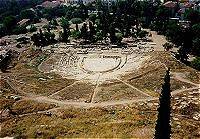
One of Pesistratus’ accomplishments was to found the institution of the theater in Athens. Thespis wins the the 1st competition of the new Great Dionysia Festival at Athens, featuring public productions of tragic drama in honor of the god Dionysus, in an early version of this theater (right) on the south slope of the Acropolis. Around this time the tradition of publicly reciting Homer at the Panathenaic Festival began, too. This was the beginning of democratic idealism: making culture available to everyone, instead of just a few. The Pesistratid tyranny will last only another 25 years or so, and then democracy will take hold in Athens. But the cultural institutions he founded lived on.
The Beginnings of Democracy 510 B.C.
In
510, Cleisthenes takes power – after the assassinations of
Hippias and Hipparchus – and completely reforms the Athenian
constitution, diluting the power of the aristocracy. His
reforms establish the Council of the 500, the Board of
Strategoi (Ten Generals), and a popular court system replaces
the aristocratically-run Council of the Areopagus,
which continues to preside only over murder cases. Cleisthenes
accomplishes all of this by drawing on both the Greek love of
competition (as seen in the Olympics and in the theater
contests), and on their equally strong love of individuality.
He artificially creates new tribes (replacing the old
aristocratic tribal loyalties) which are composed of
inhabitants of various demes (territorial divisions). Each
tribe has members drawn from demes from three different
regions – inland, coast and city. So these new
“teams” (think “color-war”) are all equal
in their diversity, since each one has constituents from all
over – no one slice of society (city merchants, sailors,
farmers) has more say than another. This is a brilliant
stroke: each deme retains control over its own local affairs,
and each deme contributes adult male citizens to the Assembly,
the new democratic ruling body of Athens.
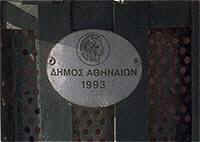
Any public structure carries the mark of the deme (DHMOS),
and I was tickled to find evidence of this even in the
municipalities of modern Greece. Here are two garbage cans,
one in Athens
(AQHNAIWN)
and the other in Pylos
(PULOU),
which clearly show the cities’ pride in public works:

At the end of the 6th century B.C., Athens is in perfect position for her next move: the progression has advanced from the hereditary monarchy in the Bronze Age to the development of aristocratically-run poleis in the Archaic Age. Soon will come the Age of Democracy – the Golden Age of Athens – a fifty-year window of opportunity that closes all too soon during the Classical Age. But first, Greece must survive the Persian Wars…
updated
August 30, 1999
Back to Dr.
J’s History Lecture Menu
Back to Dr.
J’s Illustrated Lectures
Back to Dr.
J’s Home Page
Copyright 1999 Janice Siegel