Dr. J’s Illustrated Greek Drama
to be read in conjunction with
Dr. J’s Illustrated Greek Theater
Pausanias (an ancient writer who loves to mix fact and fancy) tells us that when Aeschylus was a boy, he fell asleep while guarding a vineyard and the god Dionysus appeared to him in a dream, exhorting him to write tragedies, which Aeschylus found that he could do with ease upon awakening – to his great surprise (1.21.3). (Aeschylus is said to have been killed by an eagle, who mistook his bald head for a rock and tried to crack open a tortoise’s shell on it by dropping it from a great height.)
Pausanias also tells of a connection between Sophocles and Dionysus (1.21.2): the leader of the Spartan forces in 406 envisioned being ordered by Dionysus to honor the “new Siren” with proper funeral honors. This “new siren” he took to be Sophocles, who died just as this army invaded Attica. On the other hand, Euripides is said to have met his end, in the same year as Sophocles, by being torn apart by a pack of wild dogs, the vengeance of gods for whom he had always showed disdain. Since Euripides died in far-off Macedonia (?), this rumor could not be verified.
Origins of “theater” as we know it
The whole idea of performing songs and dances for an audience originated as a way to worship the god Dionysus, who first appeared in Greece in the area north of Attica known as Boeotia. The people honored this son of Zeus by accepting his gift of knowledge (how to cultivate grapes for wine) and establishing a cult (a whole system of worship)in his name . When Dionysus came to Attica, a local king also accepted this new knowledge, but his people – who had never tasted the effects of wine before – feared they had been poisoned and killed the king. They suffered a terrible punishment and thereafter knew the divinity of Dionysus – then they too established a cult and a festival in his honor every winter. Women ran wild in orgiastic ecstasy, all in hope that the dead world would once again come back to life after the winter was over. Another big festival was held in the spring to celebrate the renewal of life, even more elaborate and ecstatic: men dressed in goat-skins, or tragados (imitating satyrs, mythical half goat/half man creatures with huge over-sized phalluses – they represented nature and fertility) and sang songs of praise to the god (odi tragon, “goat-song” is the etymology of our word “tragedy.”)
Festival of Dionysus introduced to Athens
This crude celebration of bountiful grape harvests gradually grew into a more formalized production:
And by the time of the fifth century, drama became the number one public opinion-setting institution of the new democratic polis. This is one of the reasons that “Greek” drama as we know it through the grand masters of Euripides, Aristophanes… is almost exclusively “Athenian” drama. The tyrant Pesistratus introduced the cult of Dionysus to Athens in the 6th century and “theater” as we know it was born. There were four separate festivals of Dionysus, but it was at the Greater (or City) Dionysia, celebrated by all of Attica in the spring, where poet-playwrights competed for top prizes. This is not unlike the Olympics, which also sprang from religious ritual but appealed to the Greek competitive spirit at the same time. Thespis (where we get our word “thespian” from) is known to have won the first competition (534 BC). In Thespis’ time, the dramatist not only wrote the play, but he also composed the music, choreographed the dance, designed the costumes, and played the major role; citizens paid for all the expenses (including the actors’ pay, their masks and costumes, the sets…). In the early days, a panel of judges determined the winner of the competition.
Go through
the steps with a fictional
5th century
Athenian playwright
as he struggles to get his play produced and staged in the Festival of
Dionysus
(written by Walter Englert, Reed College)
Highly recommended!
By mid-fifth century, the competition portion of the festival lasted for three days with this format: each of three playwrights had an entire day to present his three tragedies and one satyr play (a farce). Plays were performed from dawn to dusk. Dramas from Athens would later tour the country and were again performed at the winter’s Rural Dionysia. In Pericles’ times, admission cost 2 obols, about a day’s pay at minimum wage similar to the penny Shakespeare’s groundlings paid!), although the government provided free tickets to the indigent so that all citizens, rich or poor, could participate. In later ages, admission was free for all and the audience voted for their choice of winner with their applause.
Choregic Monuments
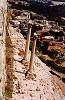
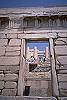
The financier of a winning play (choregos) was entitled to erect a “choregic” monument marking the achievement. The monument would then be inscribed with the names of the financing choregos, the ruling archon, and contributing artists. Lysikrates’ monument, called the Lantern of Demosthenes in Medieval times, stands almost intact in what has come to be known as the Street of Tripods, in Plaka, the old city area sprawling across the north side of town. Two remaining columns of Thrasyllos’ choregic monument still stand above the Theater of Dionysus, on the South Slope of the Acropolis. A good portion of the original inscription on Nikias’ Choregic Monument (319 BC) is preserved in the Beule Gate (AD 267), a Roman Era entry to the Acropolis made from Nikias’ spolia (fragments of older structures recycled as new building materials). Both the monuments of Lysikrates and Thrasyllos show evidence of the bronze victory tripod traditionally dedicated to Dionysus which stood atop such a structure.
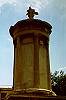
Lysikrates
Thrasyllos
Nikias
copyright
2001 Janice
Siegel,
All Rights Reserved
send comments to: Janice Siegel (jfsiege@ilstu.edu)
date this page was edited last:
11/26/2005
the URL
of this page:
https://people.hsc.edu/drjclassics/lectures/theater/ancient_Greek_drama.shtm